
3D printing.
Printing is thoroughly established for some laboratory applications and still developing for others. The useful distinction is knowing which category a given item falls into.
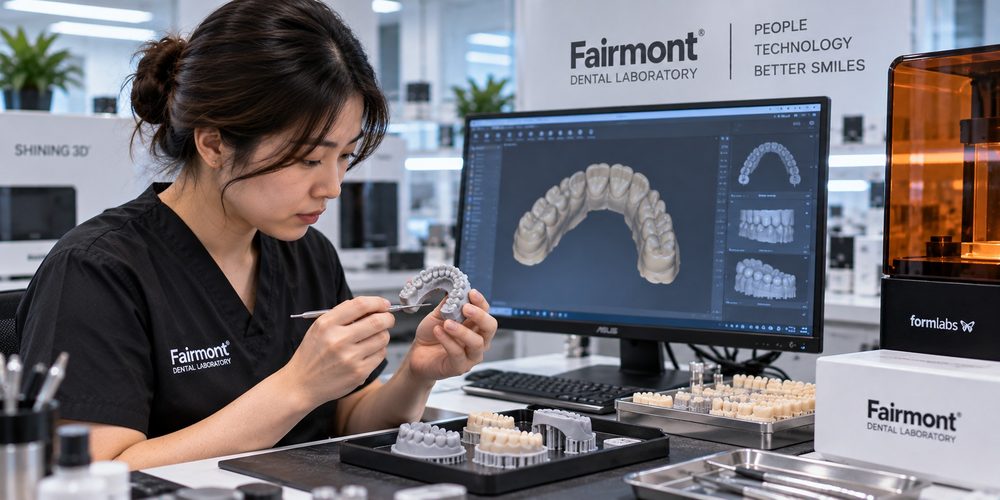
Where printing is settled
Working models and dies, custom impression trays, occlusal splints, provisional restorations and castable patterns are all routinely printed, with well-understood behaviour and predictable results.
Surgical guides for implant placement are another established application, where printing produces geometry that would be impractical to fabricate any other way.
For these, the technology is not remarkable — it is simply how the item is made now, and it produces a better result more consistently than the conventional alternative.
Where it is still developing
Printed definitive restorations are the area where evidence is still accumulating. The materials question — strength, wear behaviour, and colour stability over years relative to milled ceramics — has not fully settled.
That is not an argument against it. It is an argument for knowing which category a restoration falls into, and for keeping well-evidenced options where longevity is the governing concern.
For a definitive posterior crown expected to serve for fifteen years, milled ceramic remains the better-evidenced choice.
What determines print accuracy
Layer thickness, orientation on the build platform, support structure placement, and post-processing — washing and post-curing — all affect the final dimensions. A printed part is not finished when it leaves the printer.
Resin properties change with age and storage, and printers require calibration like any other precision equipment.
None of this is visible to a practice, and all of it is why printing is a process rather than a machine.
What it changes for a practice
Mostly turnaround flexibility and the practicality of items that were previously fiddly to make — a printed model from a digital scan, a surgical guide, a splint produced without a conventional workflow.
It does not change what the laboratory needs from you. A printed model is only as good as the scan it came from, and a printed guide only as good as the planning behind it.
If you have a preference about whether a case is printed or milled, say so. Otherwise the laboratory selects the process that suits the item.
Printed provisionals and splints
Two applications where printing has become the sensible default. A printed provisional can be produced from the same design as the definitive restoration, which means it carries the intended form rather than approximating it — useful where the provisional is testing an aesthetic or occlusal proposal.
Printed occlusal splints are dimensionally reliable, reproducible if lost or damaged, and can be remade from the stored design without new records.
That reproducibility is a genuine practical benefit. A patient who loses a splint six months later does not necessarily need a new appointment.
Surgical guides
Implant surgical guides are among the clearest cases for printing, producing geometry that would be impractical to fabricate conventionally.
A guide is only as good as the planning behind it, which depends on a CBCT scan and an intraoral scan being merged accurately. The printing is the straightforward part.
Where a guide is being made, the planning and the restorative intent should be agreed together — a guide that positions implants for surgical convenience rather than for the prosthesis produces exactly the problem guided surgery was meant to prevent.
Asking the right question
Rather than asking whether a laboratory prints, ask what is printed and what is milled, and why that choice is made per case.
A laboratory that can answer that plainly is telling you something useful. A list of machine names is not.
More in Digital Dentistry
Send a case
Digital scans and conventional impressions are both accepted. Cases move by UPS and Purolator, and Fairmont works with practices throughout British Columbia and across Canada.